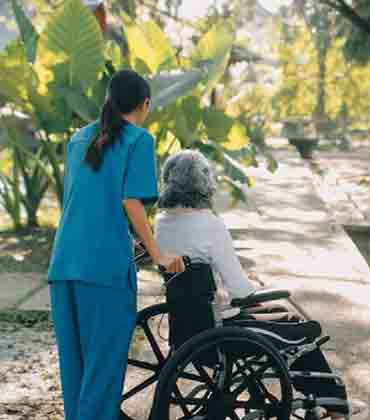
Home care nursing is one of the fastestgrowing areas of the nursing profession. As U.S. healthcare increasingly focuses on driving down costs and avoiding expensive inpatient care, attending to whole-person care across the continuum and delivering long-term care in the community for an aging population living with chronic illnesses—as home care nurses do—is now a national priority.
At the same time, being a home health care clinician involves unique challenges. Keeping patients safe and healthy at home demands creativity, collaboration, active listening, and cultural sensitivity. Home care workers use every bit of their clinical knowledge—and then some.
Home care workers are also teachers—educating and empowering patients and their family caregivers on the patient’s condition, including symptoms and prognosis, and recommending lifestyle changes for better health. They are detectives and explorers, seeking clues to health and safety around the house, from fall hazards and the supply of food in the refrigerator to unopened bottles of medicines. They are ambassadors and translators, bringing their cultural and linguistic knowledge into each home they visit and being willing to learn from other cultures. They are also allies and advocates for people in their care, especially those living on the margins.
As home care clinicians strive to keep patients active, engaged, and willing to embrace the plan of care, they can also be entertainers, dancers and singers, and even standup comedians. And in times of crisis, they are often first responders, the first ones to bring compassion and care to vulnerable people isolated by a public health emergency.
Whatever the need might be, home care workers place the patient at the center of care and then do whatever it takes to make sure that care is delivered.
For those living at the margins and may be unhoused, we also serve as community outreach workers, treating them wherever they happen. For instance, Behavioral Health Nurse Rebecca Miller-Martinez might meet her patients in the subway, on a park bench, or in a shelter—wherever they need help. “We are the marines of behavioral health,” she says.
The same could be said for many branches of home care. Judging by my colleagues at VNS Health, we are strong and on the frontlines of health care, where teamwork is everything and changing the world is in our hands.
So, what does it take to be a home healthcare worker? The short answer is Someone who combines the best qualities of a full range of professions as they advance compassionate care in the home.
Educating and Empowering (Teacher)
“Nurses are teachers,” says Ruth Caballero, RN, explaining how she works with a typical patient who has uncontrolled diabetes. Ruth provides clinical care and education about daily glucose testing, nutrition, and lifestyle changes that can help the patient lower their dangerously elevated blood sugar to normal ranges.
Home care nurse Nicole Casiano loves to hear her patients say, “No one ever told me that before.” She heard those words recently from a woman with heart failure and her son after teaching them how to check the woman’s weight every day, watch her extremities for fluid retention, closely monitor breathing, and follow a healthy diet. Nicole also says people are often more receptive to hearing such information once they get home from the hospital and back to their lives.
Going Behind the Scenes to Deliver Better Care (Detective)
Home care clinicians listen carefully and observe closely. We hear and see more than what the patient tells and shows us. Someone may say they are eating well or taking medicine properly, but a home care clinician may discover otherwise when they find an empty refrigerator or a full bottle of medication.
By visiting people in their homes and experiencing their lives firsthand, home care nurses deepen their understanding of patients’ day-to-day needs. Do they have a support system, air-conditioning to stay cool during a heat wave, or a scale so they can weigh themselves regularly to monitor heart failure?
Clinicians are always on the alert, as well, for signs of depression, anxiety, and even suicidal ideation in the vulnerable seniors they care for. Following up on warning signs and implementing the next steps is crucial to the detective work of home health care.
Creating Cultural Connections (Ambassador and Translator)
Xiang Jin, a nurse with VNS Health Personal Care, visits patients who belong to our Chinatown NNORC (Neighborhood Naturally Occurring Retirement Community). He serves as an ambassador to this group of seniors for health care and his other area of expertise, his knowledge of the Chinese language and culture. Xiang's health services include assessments, education, advocacy, and a link to resources.
“I love working with this community,” he says. “I speak Mandarin and Cantonese, and I understand the culture, so it is rewarding to help elderly clients with their unique needs.”
Being a Powerful Partner (Ally)
VNS Health’s mission has always been to provide care to vulnerable populations to address health disparities and improve lives right where people are living them—in their homes. This mission cannot be achieved without being particularly sensitive to historically neglected communities regarding healthcare access. That includes members of the LGBTQ+ community and minority communities at particular risk of chronic health conditions or societal stigma, such as Asian Americans during the early part of the COVID-19 pandemic.
Arthur Fitting, VNS Health’s LGBTQ+ program manager, recently testified before the New York City Council about the unique vulnerability of older members of the LGBTQ+ community—and about home health care’s unique mandate to keep this population safe and connected to care in the inner sanctum of their home. “We lower the institutional barriers to care by meeting our patients where they are most comfortable—in their own homes and communities,” Arthur testified.
Leading Communities through Crisis (First Responder)
Home care workers often act as first responders in public health, climate-related, or other crises. Home care clinicians have the expertise, skills, and commitment to bring care directly into the home when people— especially those who are at risk or otherwise vulnerable— are sheltering in place. We may be the first or the only ones they see for quite some time. In recent years, our nurses, social workers, home health aides, and other home care workers have been the first ones to visit the homes of people in need during major climate disasters, from hurricanes to blizzards. Most notably, they played a similar lead role during the COVID-19 pandemic, where home health nurses and other clinicians donned personal protective equipment and returned to frontline work as soon as possible.
All of these different roles have one thing in common: Whatever the need might be, home care workers place the patient at the center of care and then do whatever it takes to make sure that care is delivered. If I had to sum up the many parts home health care providers play, I would quote Nurse Desiree Gordon. In speaking of her role during the pandemic and other crises that leave vulnerable patients isolated, Desiree says simply: “You are a lifeline to them.”